
In this edition, we consider the case for leadership development and a future vision in the context of global trends. We also provide some brief updates about our work. We would like to take this opportunity to wish everyone seasonal greetings and a huge thank you for all your support.
The case for leadership development
The Global Leadership Forecast 2025 is the largest leadership study of its kind. It involved over 12,500 leaders working in around 2,000 organisations across more than 50 countries.
The research identified challenging realities about the state of leadership. For instance, trust was found to be reducing – between 2022-24 trust in leaders fell from 46% to 29%. At the same time, stress and burnout are increasing – 71% of leaders reported ‘significantly increased stress’, and 54% were ‘concerned about burnout’.
The review also revealed some opportunities to address these trends – e.g. organisations that invest strategically in supporting leaders reported marked improvements in effectiveness, engagement, and retention. People whose development has been actively supported by their leaders are far more likely to be trusting. People receiving strong support feel less burned out.
This is relevant to our leadership development programmes and to our Essentials of Transforming Leadership Book which is in its final stages of being complete having taken over a year to write.
Our book has 3 parts. Parts 1 and 2 focus on topics directly relevant to the Global Leadership Forecast findings – such as strengthening trust and developing talented people – with 12 ‘essential’ practices identified. Part 3 focuses on the wider global context, for example how can our leadership sights be lifted to more effectively tackle the systemic short and long-term issues affecting our world?
The case for changing leadership paradigms
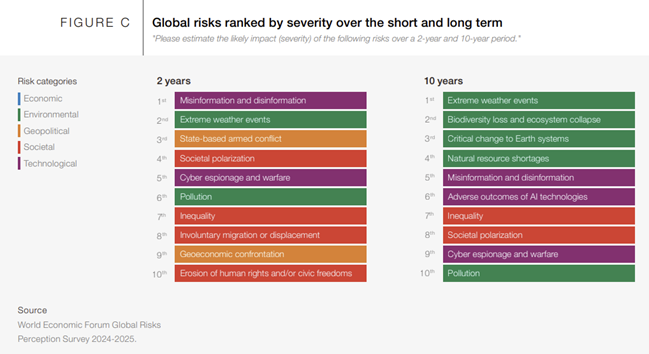
Global Risks Report 2025: Earlier this year, the World Economic Forum’s analysis identified the current top 3 global risks: ‘state-based armed conflict’, ‘extreme weather events’ and ‘geoeconomic confrontation’.
The findings below show the global risks by severity over the short and longer term. They highlight that whilst technological, societal and geopolitical disruptions may require more immediate attention (next 2 years), the environmental crisis represents the most significant long-term challenge (next 10 years).
However, since the report’s publication, progress on the environment has been very disappointing – e.g. only small steps were achieved at COP30 (the 30th UN Climate Change conference) in November.
A New Year will be with us very soon. It calls for us all to proactively contribute – in whatever ways we can – to changing prevailing leadership paradigms that have led to the systemic social, economic and environmental injustices facing our world. This includes collaborating more to address increasingly harmful and complex risks.
Each of us has agency to contribute. We can all do something to make a difference, and our actions can add to the contributions of others. As the Kenyan environmentalist and Nobel Peace Prize laureate said: ‘it’s the little things that citizens do – that’s what will make the difference’.
Part 3 of our Essentials of Transforming Leadership book sets out a vision for the future of leadership. You can read it as a standalone paper here.
Update on some of our work
We have been facilitating a programme to strengthen leadership and teamworking with CO2Balance for several years. Based in Bristol, CO2Balance is a UK-based company specialising in projects to address the environmental crisis, including by strengthening communities access to improved services. The latest session focused on renewing individual and teamworking habits.
We have been facilitating a board review with Christian Aid UK since March. Time on leadership development and teamworking culture has been integrated throughout. Based in London, Christian Aid is a large international NGO, operating in over 20 countries with an annual income of approximately £90 million. The most recent meeting concentrated on Christian Aid’s Committee structure.
If any of these themes resonate, whether about our book or examples of current activities, please get in touch.
Seasonal Greetings and Thank you!
Here is a picture of our December board meeting. As well as covering current and important governance themes, we had some fun, including a very enjoyable festive quiz. We also shared our appreciation for Emma Hillyard who was at her last meeting having been a wonderful Trustee. Her combination of strategic thinking, financial insight, and gift for making finance accessible and even enjoyable has been invaluable.
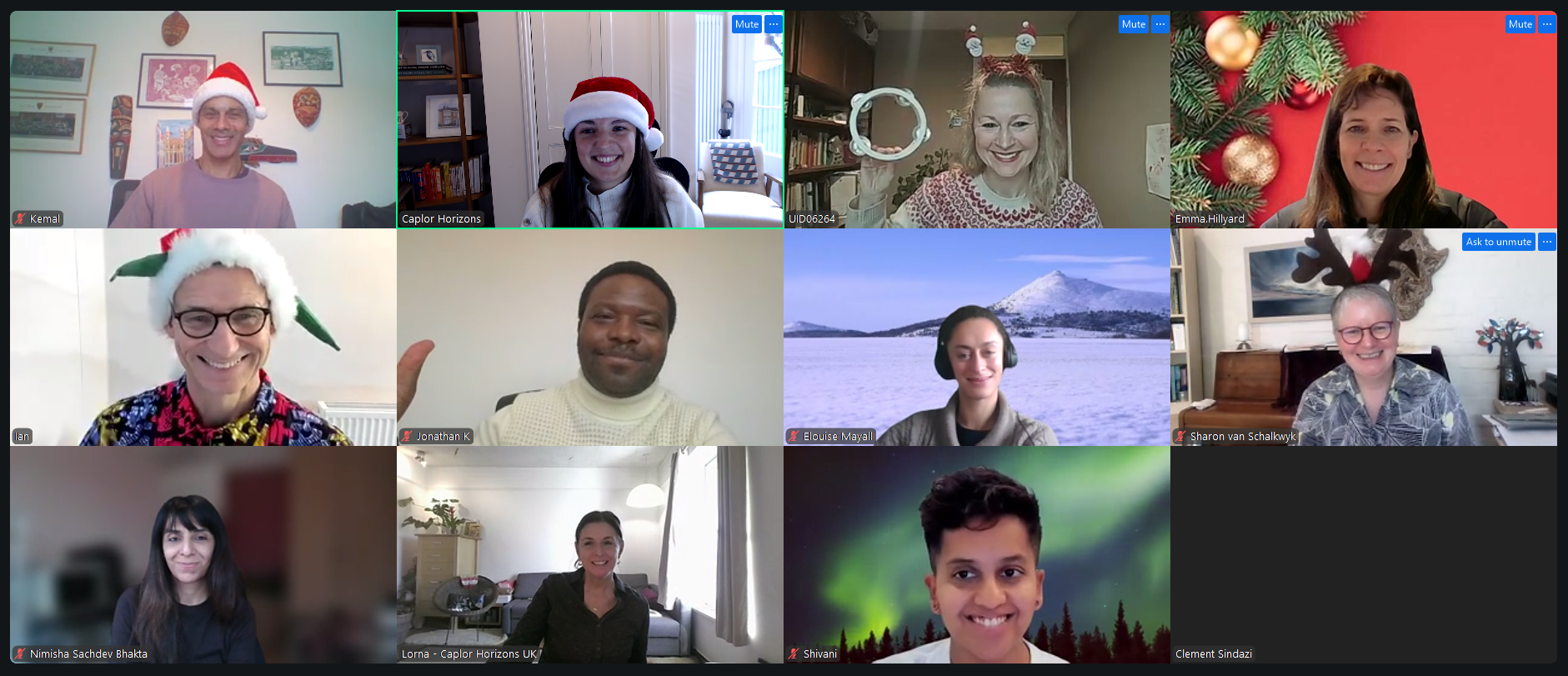
We are pleased to confirm that, following a recruitment process, Sharon van Schalkwyk has accepted the role of Finance Lead Trustee in her place. We have worked with Sharon for a number of years in relation to Ubuntu.Lab Institute and are excited for her to join our Board.
Extending this appreciation to you all, we are very grateful to all members of our community that read these newsletters and are connected with us in one way or another. Seasonal greetings to you all.
“Another world is not only possible, she is on her way. On a quiet day, I can hear her breathing.”
– Arundati Roy
Best wishes,
Ian, Rosie, Kemal and Lorna